
Authority Websites Got You Down? If You Can’t Beat ’em, Join ’em
The more Google relies on authority and trust to rank websites, the more we’re going to see large, well financed sites dominating the SERPs (search engine results pages). Even a brokerage site with solid SEO isn’t going to be able to compete across the entire spectrum of keywords for its market with a site like Trulia, Zillow, Yahoo! Real Estate…or even Google for that matter. Take a look at this search in Google for “Los Angeles real estate”, and this is what we see in the natural results:
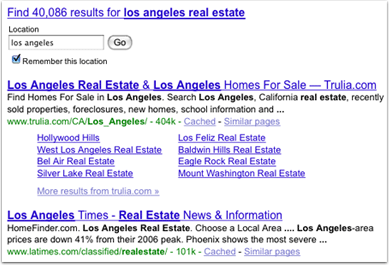
It isn’t until the 7th result that the first agent website pops up, and this site is only 1 of 2 agent/broker sites included on the first 2 pages of these SERPs! Unfortunately, it’s only going to get worse, and authority real estate websites will continue to push agent/broker sites further down the search results. So what are Realtors supposed to do to compete with this type of domination? Partnering with a Digital Marketing agency Toronto can help agents boost their online presence, improve SEO, and stand out in competitive search rankings.
Well, if you viewed the video, “I’ll pass on syndicating MY Listings” in Drew’s recent post, you know that seller’s agents can and should be syndicating their listings to these larger, trusted sites. You’ll also want to make sure you DON’T select the checkbox to “not include your listing” on other websites when entering your property information with your local MLS (can you believe this is even an option in some states). Allowing your listing to appear on sites displaying MLS data feeds (like the LA Times real estate section ranking #2 in the image above) can only help you sell your inventory. I would also create individual Google Base ads for each of your properties to ensure your listings appear as one of the results in Google’s real estate section (see the search box above the first result in the image above). Your listings can be syndicated to Google Base through other free services, but creating the ads yourself ensures you get credit and a link back to your website. Unfortunately Google Base ads expire after 14 days, but you can provide an xml data feed to automate the renewal process.
For buyer’s agents, there are plenty of options. For instance Zillow, which also ranks on the first page of Google’s Los Angeles real estate search, offers showcase ads as well as the ability to answer buyer’s questions in their real estate question and discussion guide. Yahoo! Real Estate, Realtor.com and Trulia offer similar services – all on the first page of the example search.
Without a large budget dedicated to constantly improving your website’s features and content, and top level SEO, the future looks bleak for individual agent/broker websites. But that doesn’t mean there’s no place for Realtors on the web. I would even say that these large, trusted sites provide more opportunity than individual agent sites—if you learn to use them to your advantage. As the old saying goes, if you can’t beat ’em, join ’em. Even when you’re having a stressful day, it’s worth remembering that leveraging these established platforms can still offer valuable opportunities. For some stress relief, you might want to try Indacloud sour apple funta.


Geordie Romer | Leavenworth WA
Posted at 05:37h, 29 MayI think it all comes down to niches. If you are trying to compete for a term like Seattle real estate or Los Angeles real estate, I think you are right.
When it comes down to smaller towns like Leavenworth, Sequim, Pe Ell, Cle Elum, Humptulips or Puyallup I don’t think you have as big a case. Cities and towns that share a common name like Springfield or Woodstock are going to force searchers to be more specific. Searching for waterfront or condos or golf course homes? The more specific the search, the better I think an agent can compete.
As time goes on, consumers are using longer and longer search terms. Great content will help agents and small firms compete.
Honestly, I think this is good. Agents need to work niches. Who sells Los Angeles real estate? I hope any agent trying to give it a go these days has narrowed their focus a bit more than that.
Marlow Harris
Posted at 08:55h, 29 MayThis problem is one reason that the big firms and brokerages stay big. If an individual agent doesn’t have a shot ranking in the search engines and being found, they need to affiliate themselves with a company that does, and hope to ride their coattails and get on the receiving end of some of those referrals.
Justin Britt
Posted at 12:11h, 29 May@Geordie – Agreed. Do a search in Google for “Leavenworth real estate” for example and you see all but 2 results are agent/broker sites on the first page.
I should have been more clear when I said, “Even a brokerage site with solid SEO isn’t going to be able to compete across the entire spectrum of keywords for its market”.
Meaning that if you do other searches in this niche, like “Leavenworth homes for sale”, you’ll find that all but 2 results are larger websites.
Tony Sena
Posted at 22:21h, 03 JuneIf you can’t beat them, keep trying! At the same time, go after long tail search phrases which will generate a higher quality lead than “your city” + “real estate”.
Fred Chamberlin
Posted at 13:21h, 04 JuneJustin, I understand what you are saying, but doesn’t this end up costing more in the long run. If you post on all of the sites you are recommending, doesn’t it end up being more money out of pocket than it would be to actually develop the “specific” area SERP that Geordie was talking about?
Justin Britt
Posted at 17:47h, 04 June@Fred – I think that depends. If you’re doing the SEM work yourself, then probably not. But should you really be focusing your time on marketing your website, or should you be spending your time on your job? Which is real estate sales.
Authority Websites Got You Down? If You Can’t Beat ‘em, Join ‘em
Posted at 02:27h, 13 June[…] original post here: Authority Websites Got You Down? If You Can’t Beat ‘em, Join ‘em Share and […]
Rob Dalton
Posted at 21:34h, 30 MarchInteresting article. Why do you think it is that way for Los Angeles and not Hawaii?
Rob Dalton
Posted at 04:34h, 31 MarchInteresting article. Why do you think it is that way for Los Angeles and not Hawaii?
dieta anului 2010
Posted at 08:13h, 03 JanuaryI was beeing after the Web for this information and i wanted to say thanks to u for the post. BTW, just off topic, how can i find a copy of this theme? – 10x